TyRex Featured Alongside Industry Experts in Austin Business Journal Roundtable
Trevor Hendricks2025-09-17T20:40:23+00:00The following was originally published by the Austin Business Journal on September 12, 2025.
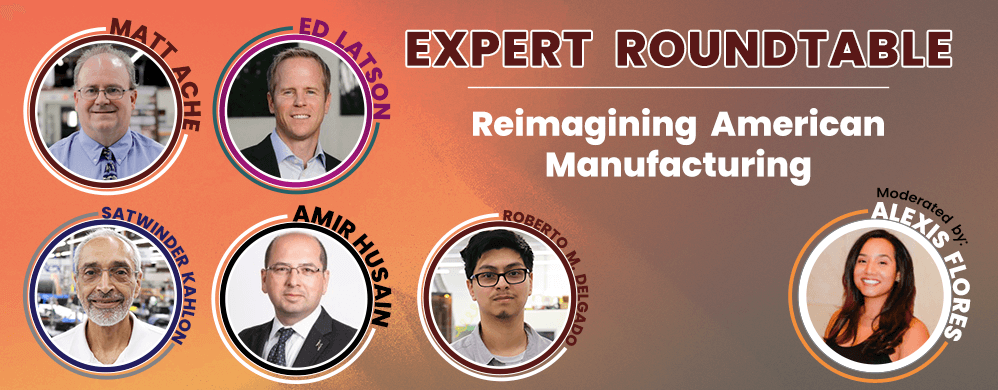
As the future of manufacturing takes shape, leaders across the country are rethinking how to stay competitive in a fast-changing global market. To explore what’s ahead — and what it will take to succeed — the Austin Business Journal convened a panel of innovators, industry leaders and emerging talent. Panelists included Amir Husain, serial technology entrepreneur and author of the upcoming book The Cybernetic Society; Ed Latson, CEO of Opportunity Austin; Satwinder Kahlon, President of Saber Data and co-leader of TyRex’s AI Technologies TEAM; Matt Ache, President of the TyRex Technology Business Family; and Roberto Macedo-Delgado, a senior at Texas State University and summer intern. Together, they offered an inside look at the evolving landscape, from AI and workforce shifts to new opportunities for U.S.-based production. The conversation was moderated by Alexis Flores, Director of Workforce Development at the Austin Regional Manufacturers Association.
Alexis Flores: Amir, what is your vision for the future of U.S. manufacturing over the next five to 10 years? What do you see as the legacy being built and the work being done?
Amir Husain:
The three biggest challenges plaguing U.S. manufacturing are labor, cost, and conversion of innovation. First, there’s the shortage of labor and expertise. This became very clear with the new semiconductor plants brought to the U.S. in partnership with the Taiwanese. Every report you read about those projects says the labor trading wasn’t up to par, and that’s a major issue for advanced, high-margin manufacturing.
The second issue is around the cost of production. I check this every quarter, and the last time I did, I read that the average amount of money that the French spend to build a mile of highway is half of what we spend. In America, everything has become extremely expensive to build, and this reflects in our defense manufacturing base, where we’re locked into building multibillion-dollar assets. It applies to infrastructure; it applies to pretty much everything.
Third, is that the technologies we’ve developed in universities and small companies haven’t made their way to the fore. This is one of America’s greatest advantages, yet it’s not translating into the next generation of dominant American products, platforms, or systems the world wants. Part of that is global competition, but part of it is that we’ve gotten worse at converting that pipeline into a successful product.
An optimistic future for American manufacturing means we address these systemically. Some of the fixes will require policy intervention. Others will require education, artificial intelligence, and immense amounts of automation. We have some tools to fix this. The question is: How do we execute? And how do we hold ourselves accountable as we work toward solutions?
Alexis Flores: Matt, you’re at the forefront in shaping the future of manufacturing. From your perspective, what does the bigger picture look like for U.S. manufacturing moving forward?
Matt Ache:
Looking at the future of manufacturing, we’ve done some deep thinking around what we call “Technology Time,” and we’ve written a number of white papers on it that really addresses the accelerating speed of technological change. Today, technology is doubling the world’s knowledge in about an hour and a half. In five years, it’ll be less than an hour.
Faster innovation means shorter product life cycles. So how do businesses — and manufacturing in particular — keep up with that kind of rapid evolution? First, companies need to build what I’ll call a “conveyor belt” of new product ideas — a system for continuously developing and launching products with much faster time to market. That includes accelerating engineering processes to get products designed and ready much quicker than we do today.
At TyRex, we already have a solution! By using our in-house AI-aided technologies, we have Captured the Near Totality or the Universe of New, Unique Product Ideas from the internet. Currently we have found and secured over 450,000 FOM Product Ideas Securely Stored in our Cosmic Inquiry Data BoxSM. Each Product is New and Unique, sorted by NAICS code, and 3D Printable. Each has its Own Product ID and Initial Search description. We have confirmed we can go from Concept to Prototype, and create New, Unique 3D Printed Products in Days. We are looking to create partnerships with manufacturing companies to help them create their “conveyor belt” of new products. We also identify products internally and put them on our Ascending Virtual Bulletin Board along with our Schedule of amazing Summer Interns’ Engineered New Product Ideas with 3D Printed Prototypes. We also surround these nearing 500,000 plus New, Unique Product Ideas with 20+ Connecting and Cross-connecting TyRex Technologies TEAM AI-Aided Software Programs that Create a Virtual Picket Fence of IP Protection from Non-invited Foreign Entities.
Alexis Flores: Ed, let’s zoom in a bit. What are you seeing locally in Central Texas and Austin when it comes to the future of manufacturing? What trends or dynamics stand out to you?
Ed Latson:
I think this is a pivotal moment — not just for the country, but globally. There’s been a true recognition that, to be a safe and secure nation, we have to be resilient in a few key areas. That includes owning our production capacity in pharmaceuticals, technology, and defense. I think we’re going to see much more concentrated investment in those sectors over the next five years.
Austin is incredibly well positioned to lead in this transformation. Between 2018 and 2023, we were the top-performing economy in the country. We led in job creation, population growth, and GDP growth. A lot of that momentum came from manufacturing.
Some of the biggest, most premier projects in the world landed here. Tesla built the largest factory in the world in Austin. Samsung made a $40 billion investment in Taylor, and now we’re seeing multiple suppliers moving in to support that facility. These are some of the most advanced, cutting-edge facilities, and I think it’s a testament to the strength of our workforce and the ecosystem we’ve built around it.
Alexis Flores: Satwinder, I’m curious to hear your thoughts on Austin’s contribution to the future of manufacturing. Where do you think we stand over the next five to 10 years?
Satwinder Kahlon:
Austin is definitely in a strong position. I moved here 30 years ago, and have been in the technology world since then. During that time, I have seen the evolution through the different technologies that have come out of Austin. I’ve watched the changes come through — whether that’s the work coming out of research labs, or big decisions like why Google or Amazon came to Austin.
Those companies helped drive that evolution. And here at TyRex, which was founded 30 years ago, we’ve been part of that same journey. The technologies we’re building now are looking toward where manufacturing is going, not only in Austin but across the U.S. and worldwide. Still, our main focus is U.S. manufacturing. We’re building solutions that are meant to help manufacturers across the country and reduce supply chain issues.
Alexis Flores: That brings up an important point — how will we know if we’re on the right track? What signs or metrics show that Austin is keeping pace with advancements in manufacturing and technology?
Satwinder Kahlon:
For us, every technology we’re building goes through a validation process. Whether it’s a product concept or a new system, we take it through the steps to confirm that it’s viable and can be implemented.
To support us, we bring in youth organizations to be part of that process. They benefit by learning about the evolving technology here in Austin and gaining opportunities to contribute. They are the ones telling us, “Yes, this product can be ready in 15 days for $15,000.” So across our technologies and companies within TyRex, we’re constantly evolving and validating as we go, working with customers and moving forward.
Matt Ache:
It really comes down to measurement. With a lot of the new systems we’re using at TyRex, we can track how quickly we’re doing things and where we can improve.
As I mentioned before, one of the tools we’ve created is something we call the Cosmic Inquiry Data BoxSM. It helps us streamline and expedite the creation of new product ideas. In the past, that might have been a roundtable of people brainstorming. Now, we can accelerate the front end of engineering by using AI software tools to pull those ideas together more quickly reducing the engineering time to create new products by 60 to 80%.
We’re able to measure how fast we go from concept to prototype, and from prototype to preproduction and full production It all goes back to what I mentioned earlier about the speed of technology. Keeping up with it means we have to measure constantly — time, cost, everything.
And to Amir’s point about costs in the U.S. versus other countries, combining TyRex advanced technologies like AI, additive manufacturing, and 3D printing give us a real opportunity to keep manufacturing and manufacturing jobs in the U.S. We’re reaching a point where we can produce new product ideas in the U.S. at a much more competitive cost than low priced labor countries, where we won’t need tariffs to compete.
Our goal is to be a leader in bringing manufacturing back to the U.S. and for the U.S. to regain the title of No. 1 manufacturing nation in the world. With the new technology, the speed of technology and what we can now do internally, I believe, with these TyRex tools, we can help our partners get there.
Alexis Flores: Ed, with increasing global supply disruptions, what strategies are local manufacturers using to strengthen operations and build more resilience here at home?
Ed Latson:
Geopolitical dynamics are really influential right now — not just in how companies operate, but also in where they choose to invest and produce products. Some of those decisions are driven by customers, and some by the companies themselves.
We’re seeing a much more regionalized focus, as opposed to long, extended supply chains. Companies are looking for strong suppliers and partners who can help them achieve their targets and goals.
At the same time, technological advances are giving companies better tools to make more informed decisions. So the strategy is to diversify, keep supply chains closer to home, and deploy tools that improve efficiency in the process.
Satwinder Kahlon:
Adding on to Ed’s comments, at TyRex we see a manufacturing revolution coming. The future of the Manufacturing industry is dramatically changing as manufacturing moves to becoming more virtual in nature. At TyRex, with virtual design, to virtual development and virtual testing, we strive to make the technologies less expensive and easier to build. Remote 3D Printing at any location is another area where we have put together solutions to make manufacturing more efficient. All these virtualization techniques supporting Future of Manufacturing are the pillars being developed at TyRex.
Alexis Flores: Amir, I’d love to hear your insight on this.
Amir Husain:
There are two levels to this conversation: the global piece and the local piece.
First, you have to define what Austin is. Austin is home to UT Austin, one of the largest universities in the country and consistently ranked in the top 10 in nearly every important subject. There are also several second- and third-tier universities in Texas providing further labor. Then, you have the Army Futures Command — the first four-star command established in decades, headquartered in Texas. Its effects haven’t fully played out yet, but it’s a significant asset for the state.
Texas is also building itself into the center for space innovation in the U.S. We already had NASA, and now we have Jeff Bezos’ company Blue Origin, Elon Musk’s SpaceX, and local Austin companies building rockets and numerous other surrounding technologies. Even Virgin Galactic aims to operate out of Houston.
One of the reasons China maintained its lead for so long was deep integration across all phases of the supply chain — not just finding a part or a board, but knowing the exact solder, the specific size and metal of screws with the right tolerances, every resistor — the whole nine yards. I think we have a real opportunity to build that kind of integrated U.S.-focused space manufacturing ecosystem here in Austin.
Alexis Flores: Satwinder, I see you nodding. When it comes to manufacturing, what challenges or trends are standing out most right now?
Satwinder Kahlon:
At TyRex, one of the big challenges is the manufacturing supply chain — the need for so many components and parts. While supply chain issues will always exist to some degree, we’re trying to develop product ideas that can move forward with minimal supply chain disruptions.
The product concepts we’re working on evolve over multiple stages, and those solutions are where our focus lies for the future of manufacturing. We’ve published research articles and white papers on this, all under the Spirit of American Manufacturing (S.A.M.). Building on those concepts, we’re helping manufacturers figure out how their product portfolios should evolve.
Alexis Flores: Matt, what’s on the drawing board to address these challenges and shape the future of manufacturing?
Matt Ache:
At TyRex, we’re supporting a movement to bring manufacturing back to the United States. Right now, about 80% of the products designed or developed here end up being manufactured overseas. That creates geopolitical challenges, like tariff uncertainties, and we lose control over our own fate.
TyRex is using an AI, AM (Additive Manufacturing), and 3D Printing connecting concept that eliminates the majority of the supply chain. We are prepared for the U.S. Manufacturing radical change with the aid of advancing TyRex AI-aided technologies to its virtual and additive manufacturing future programs. With TyRex’s manufacturing capabilities related to global supply chain disruptions, the TyRex Technology TEAM’s leadership in the Spirit of American Manufacturing (S.A.M.) addresses this concern as well. With additive manufacturing, you start with essentially nothing and with 3D printing, create products. Couple AM with AI-aided software and TyRex Technology TEAM’s new, unique product from its Cosmic Inquiry Data BoxSM and you have essentially eliminated all concerns related to global supply chain disruptions. U.S. Manufacturing is now moving toward a more virtual, time and cost effective, competitive business structure.
Alexis Flores: Amir, how does being based in Austin — a growing tech hub — shape employers’ access to innovation, talent and research partnerships?
Amir Husain:
Austin’s top talent really comes from several sources. First, UT Austin — it has top-ranked departments in computer science, electrical engineering, architectural engineering, mechanical engineering, aerospace, and more. The accounting program also ranks number one in the country. So there are these clusters of excellence where significant capability exists.
The question is how to organize and corral this talent to create big local opportunities. Apple’s second-largest operation globally is now in Austin, but it mostly handles lower-level work while the more cutting-edge roles tend to go to California. Tesla is starting to bring more interesting work here, and Samsung’s new fabrication plant, which recently expanded in partnership with Tesla, is a big opportunity. So these are some very specific opportunities to take a deep look at.
Texas, and Austin in particular, is well positioned to be a manufacturing hub. It has access to ports, affordable land, strong universities, relatively low costs, many small towns for manufacturing facilities and lighter regulations. There’s even a $175 million-a-year space innovation fund the governor established for space-focused research and companies. Many of the pieces are in place — someone just needs to bring them together, like a commercial czar working with the government to align all the threads and deliver results.
Alexis Flores: Ed, at Opportunity Austin, you work across all industries. How does Austin position itself as a good opportunity for companies in manufacturing?
Ed Latson:
Here in Austin, I think we help solve many of the challenges manufacturers face around the country. A great example is Tesla — they hired 20,000 people in one year for one of the most advanced factories in the world. When you hear about labor shortages or complaints about training in other parts of the country, that’s not what’s happening here.
We have an incredible workforce ready to meet the needs of companies. Within 100 miles of Austin, there are more than 400,000 students, including top engineering programs. Texas has more tier-one universities than any other state in the country, and all that talent is focused and harnessed here.
Austin’s culture of innovation is unsurpassed. In the last five years, more than 29 unicorns have emerged in the area, and Austin captures 50% of the state’s venture capital. We’re the No. 2 location in the country for hardware funding.
Another advantage is that Austin ranks No. 1 in the nation for foreign direct investment per capita. It’s a city with global reach, which helps companies scale and accelerate ideas in a unique way.
Alexis Flores: Matt, the business landscape has changed a lot since TyRex got started back in 1995. How do you continue to evolve and get your employees to lean into the change?
Matt Ache:
Special by Design® has always been at the core of TyRex’s business culture and employee business family inclusive “SHARED SUCCESS” philosophy. Because The Future of Manufacturing (FOM) will have a focus on AI-aided additive manufacturing and 3D printing, over 95% of our TyRex Technology Business family have taken multiple levels of 3D Printing and New Product Design classes. This isn’t just the folks on the floor — it’s accounting, every person in every position throughout the organization has access to that knowledge.
But at TyRex we like to think beyond outside the box, because even the accounting person might have a hobby that sparks the next new product idea and helps speed things up.
Many TyRex employee awards and accomplishment recognitions feature a 3D Printed item such as 3D Printed music, art, food, and future of fashion initiatives. These Programs are accessible for all of TyRex’s employees and these achievements have come from people in every division within TyRex.
Another thing we’re doing, and Satwinder might be able to add here, is moving from just automated manufacturing to virtual collaboration. Using VR lenses, we can bring together experts from across the world. When they’re done, they can print the product via additive manufacturing. The speed difference from what we used to do is huge, and this helps us connect employees and customers, accelerating the whole process.
Satwinder Kahlon:
Adding a bit more to that — one thing that’s impressed me from day one is how strongly employees are encouraged to be entrepreneurial. At every step, every employee is encouraged to come up with ideas.
For example, one of our engineers was asked by a large company to test some chips. She came up with the idea of a 3D-printed container that would hold the chips and allow testing in one place, instead of multiple locations. That’s a great example of entrepreneurship — coming up with a concept and taking initiative to solve a problem. She filed the patent for it, and we hold that patent now.
And now TyRex is combining and connecting its own real manufacturing youth research program with AI entrepreneurial training and tools.
In our youth program, they are presented product ideas that need to be engineered. We sometimes have to tell them to stop engineering, because a product at a certain point needs to be finalized. Seeing the youth innovate inspires our employees.
So going back to your original question about TyRex and how we encourage innovation — this culture is evolving and spreading into other industries and organizations. It’s helping build American labor and knowledge bases, and encouraging contributions that create entrepreneurs.
Ed Latson:
Satwinder, you mentioned how entrepreneurial skills are so relevant on the floor, and I agree. I don’t think young people always understand the kind of careers they can have in manufacturing. It’s incumbent on all of us to inspire them to pursue the educational background necessary to succeed.
Alexis Flores: Workforce is a topic across all industries. What should companies be doing to foster a culture of innovation and continuous learning? How does our education system, from K-12 to higher learning, play a role in this?
Matt Ache:
At TyRex, we believe developing Real World Technical and Business Education Programs to Complement Higher Education Learning Seems to Have Extraordinary Implications. We have completed programs with Summer Interns, giving them early Access to TyRex AI AI-aided software Technologies which Has Been a Huge Success. TyRex wishes to expand with its RecognizeGood.org and Area Educational Entities’ partners to develop special technical programs. It is exciting to have the opportunity to see prior to entering the real-world business and the Future of Manufacturing (FOM) in the form of new, unique product design, engineering, and 3D Printing every day during the summers at TyRex.
We have also, brought in a lot of STEM programs through tours showing them what the future of manufacturing will look like. We also want to attach those visits to real opportunities. For example, we’re working with some high schools on creating fidget tools that hospitals can use to help patients improve finger dexterity. That raises questions like: How do you build a business model around that? How do you use additive manufacturing to create a sustainable model while giving back to the community?
Roberto M. Delgado:
Fostering a culture of innovation and continuous learning begins with creating a positive and supportive learning environment. Organizations should prioritize spaces where curiosity is encouraged, collaboration is valued, and new ideas are welcomed without fear of failure. This environment empowers employees to take calculated risks, share diverse perspectives, and actively seek out new knowledge, which are all critical to sustained innovation.
Our education system plays a foundational role in shaping this mindset. From K–12 through higher education, teachers serve as the catalysts who inspire and guide the next generation of learners. The influence of an engaged, passionate educator can ignite curiosity, build confidence, and instill a lifelong desire to learn. By equipping teachers with the resources, professional development, and support they need, we can ensure they continue to nurture the critical thinking, adaptability, and problem-solving skills that prepare students not only for today’s challenges but also for the evolving demands of tomorrow’s workforce.
Matt Ache:
Another big element is connecting with the community. TyRex underwrites the Ethics in Business Awards for Central Texas. We work closely with Concordia University and a lot of schools to help select honorees for business ethics awards. This focus on ethics is important, especially as organizations navigate challenges like integrating AI. Having that ethical rudder is crucial as we build systems and ecosystems. TyRex desires to become a manufacturing leader by combining advanced AI-aided TyRex technologies with national patriotism and restoring our U.S. manufacturing pride to what it was 50 years ago.